
The Benesse Group aims to contribute to all of the SDGs by addressing SDG Goal 4, "Education." In its environmental initiatives, the company provides environmental education services tailored to children's developmental stages, promoting understanding of climate change and biodiversity, and encouraging action to address these issues. Furthermore, the company has set targets for reducing its own GHG (greenhouse gas) emissions and is promoting a decarbonization transition plan.
Climate-related information based on TCFD recommendations
In 2019, Benesse Corporation became the first education provider in Japan to endorse the TCFD recommendations. We have conducted scenario analyses in line with the TCFD recommendations for our domestic education business, deepening our analysis of the impact of climate change risks and opportunities on our operations. Moving forward, we will continue these activities with the goal of "leaving a beautiful global environment for children, who are like exchange students from the future."

For more detailed information, please see below.
Biodiversity-related information based on TNFD recommendations
Benesse Corporation's business activities rely heavily on natural resources, including paper. To ensure that our business activities do not negatively impact biodiversity or the natural environment, we are working to reduce resource consumption through the digital transformation (DX) of our business models. Furthermore, in raw material procurement, we are committed to sustainable procurement that considers the natural environment and promoting recycling and reuse.
Furthermore, taking into account the characteristics of our business as an education business, we will expand educational services related to environmental education and biodiversity conservation for people of all ages, from children to adults. By doing so, we will promote a greater awareness of the value of natural capital in society, and ultimately encourage behavioral change among people, thereby contributing to the realization of nature positivity as outlined in the Kunming-Montreal Biodiversity Framework and the National Biodiversity Strategy.
As part of our efforts to address biodiversity, which is closely related to climate change, we endorsed the TNFD (Task Force on Nature-Related Financial Disclosures) in 2023, participated in the TNFD Forum, and registered as a TNFD Early Adopter. We are continuously evolving our activities year by year towards realizing nature positivity.
For more detailed information, please see below.
Indicators and targets
(Benesse Corporation)
<Climate Change>
We have further raised our targets for Scope 1 (emissions from Benesse's own combustion of fuels such as gas) and Scope 2 (emissions from the use of electricity, heat, and steam at our own facilities). In May 2021, we received certification from the Science Based Targets initiative (SBTi) for our "Well-Below 2°C level" target, which has now been updated to a "1.5°C" target and recertified. Furthermore, for Scope 3 (emissions from Benesse's value chain), we have set reduction targets for 2030 and 2050, using 2018 as the base year, in line with the 2°C target.
● Scope 1, 2, and Scope 3 reduction targets
Fiscal year ending March each year
| Every year * | 2030 * | 2041 | 2050 * | |
|---|---|---|---|---|
| Scope 1 and 2 reduction rates based on 2018 | 4.4% | 52.8% | 100% | 100% |
Fiscal year ending March each year
| Every year | 2030 | 2050 | |
|---|---|---|---|
| Scope 3 reduction rate with 2018 as the base year | 1.23% | 14.8% | 39.4% |
<Biodiversity and Resource Conservation>
In addition to the above GHG emission reduction targets, we aim to achieve the following:
- Procuring paper that does not contribute to deforestation: Reducing paper consumption and maintaining 100% procurement of paper that does not contribute to deforestation.
- Reducing resource consumption: Reducing paper usage through DX, and considering and implementing BYOD (Bring Your Own Device) for tablets.
- Adoption of printing methods with low environmental impact: Expansion of environmentally friendly printing methods and expansion of the use of environmentally friendly inks.
- Promoting the recycling and reuse of teaching materials and equipment: Continuing the collection of teaching materials and toys, continuing and expanding tablet reuse, and continuing the recycling of waste at each location.
- Promoting supply chain management related to natural capital: Maintaining communication with paper manufacturers and printing and binding companies, and considering requests and collaborations as needed.
- Promoting environmental education services, including biodiversity: Expanding the content offered.
Achievements
Please refer to the following results from our "Sustainability Data".
- Reduction results for Scope 1, 2, and Scope 3
- Energy consumption, water consumption, waste generation
In addition to the above, we have also achieved 100% maintenance of paper procurement that does not lead to deforestation (FY2024).
Main initiatives
Initiatives in products and services
- Promoting the digitalization of products and services
-
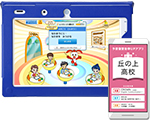
Benesse Corporation's Shinkenzemi has provided paper-based learning materials since its inception, but in 1999, it launched the "Shinkenzemi Second Year Course Challenge Net Course" using the internet. Since then, it has provided digital learning materials that cater to the individual needs of each customer. The currently offered "Challenge Touch" leverages the characteristics of digital technology to analyze each child's learning data, such as daily progress, target academic ability, amount of study, and textbook type, to propose an individualized curriculum and contribute to improved learning effectiveness. In recent years, the percentage of students choosing digital learning materials has increased, leading to a reduction in paper resources. As of April 2024, the percentage of digital courses is approximately 70% for both the "Elementary School Course" and the "Junior High School Course." In addition, the submission and return of "Red Pen Teacher 's Problems," which were previously handled by mail, can now be done digitally, shortening the time and contributing to a reduction in CO2 emissions during transportation. Benesse is also working to promote the reuse of tablets provided with Challenge Touch. Moving forward, Benesse will continue to contribute to reducing environmental impact through its business while enhancing the learning effectiveness of children.
- We use only raw materials sourced from properly managed forests.
- We also take environmental considerations into account when sourcing raw materials.
The wood used as raw material for our paper is sourced from forests certified as being properly managed. Furthermore, the cardboard used for product packaging is made from 100% recycled paper.
In terms of paper usage, we utilize recycled paper and paper treated with environmentally friendly bleaching agents for over 99% of our operations. - We have introduced biomass-certified inks for printing on our shipping envelopes.
-
Benesse Corporation uses ink containing bio-derived resources (biomass) in the envelopes it sends out for shipping. In implementing this, we display the biomass mark in accordance with the regulations of the Japan Organic Resources Association.
Because different types of ink are used, the biomass mark may vary depending on the product.
- Environmental considerations for ink and paper in commercially available magazines by Tamahiyo
-
Benesse Corporation's commercially available magazines for expectant mothers and new mothers, "First-Time Tamago Club," "Mid-Term Tamago Club," "Late-Term Hiyoko Club Tamago Club" "First-Time Hiyoko Club," "Mid-Term Hiyoko Club," use environmentally friendly inks (vegetable oil inks) and paper (FSC® certified paper) (with some exceptions) for the sake of your baby's future.
Please see below for details of the initiative.

Office activities
- Promoting floor activities that ensure thorough waste sorting and energy conservation.
- We participate in the Ministry of the Environment's "Deco-katsu" initiative, promoting the implementation of Cool Biz and Warm Biz, meticulous efforts in air conditioning and water usage, and the conversion to LED lighting. We also inspect and report on whether waste sorting and air conditioning settings are being properly implemented on each floor, and we strive to promote environmental activities by conducting environmental training in each department.
- Tracking and reducing copy paper usage
- We track and manage the monthly copy paper usage for each department, both per person and in terms of cost. Compared to when we started in 2005, we have reduced usage by more than 60%.
- Reuse of office supplies
- Our Southern Headquarters (Okayama) and Tokyo Headquarters (Tama) have recycling rooms for various office supplies, which are always kept in a well-maintained state for easy use by employees.
- Efforts to achieve zero CO2 emissions at shareholder meetings
-
We are collaborating with Okayama City to offset the CO2 emissions generated from the creation and transportation of shareholder meeting notices, the travel of shareholders and staff attending the general meeting, and lighting and air conditioning on the day of the meeting, through a carbon offset initiative.
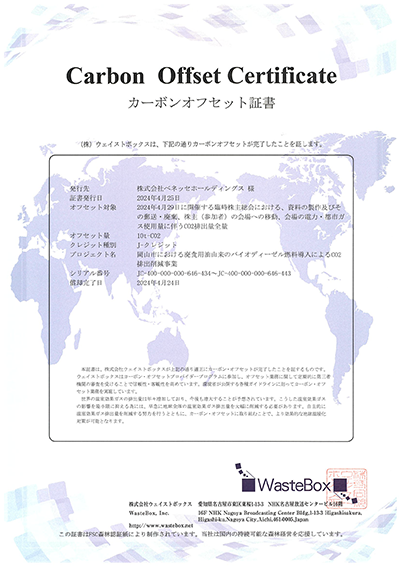
2024 Carbon Offset Certificate [PDF: 372KB] Carbon offset certificates from previous years
- Participating in the Ministry of the Environment's "Environmental Value Trading Demonstration" project.
-
We participated in the Ministry of the Environment's "Environmental Value Trading Demonstration" project and offset 25 tons of CO2 in energy consumption at our Minami Head Office in fiscal year 2019.
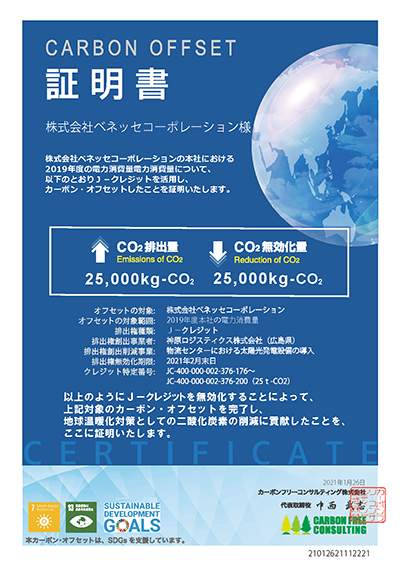
Carbon offset certificate - Realizing "Tokyo Zero Carbon 4 Days in 2020" and participating in cooperation with "Tokyo 2020 Games Carbon Offset"
-
Prior to the 32nd Olympic Games (2020/Tokyo) and the Tokyo 2020 Paralympic Games, we provided credits to the Tokyo Metropolitan Government to offset greenhouse gas emissions from the opening and closing ceremonies. This credit provision was made possible by exceeding our greenhouse gas reduction targets through our office activities.
The donation amount was 719 t-CO2. A detailed explanation is provided below.
The schemes that generated the credits I held are as follows:
Initiatives in procurement and logistics
At Benesse Corporation, we manufacture and deliver a large number of products to our customers every year. Therefore, we are committed to environmentally conscious practices throughout every stage of our process, from procurement to logistics.
For example, even when creating a single educational booklet, the procurement and logistics departments and on-site staff collaborate to promote activities such as reviewing product specifications to minimize waste, actively procuring environmentally friendly printing paper, and improving the accuracy of print run determination to reduce waste. Externally, we also consider the environmental impact by collaborating with suppliers at each stage of the process, such as evaluating the environmental efforts of manufacturing plants and reconsidering efficient delivery methods.
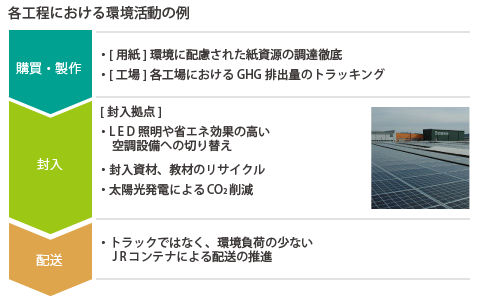
- Considerations when procuring raw materials
-
Benesse Corporation has established comprehensive guidelines for green procurement in its raw material procurement process. Furthermore, we collaborate with our business partners to ensure environmental considerations. Specifically, we implement the following activities:
- We have established procurement standards for paper and raw materials for educational materials and toys, as well as product safety standards during manufacturing. In particular, we strictly prohibit the use of materials with environmental impacts and have established and implemented an inspection system.
- As part of our sustainable sourcing efforts, we purchase paper from paper suppliers that is certified by SGEC (Sustainable Green Ecosystem Council) forests *. We also collect information on planting countries through SGEC's activities.
SGEC forest certification is mutually recognized with PEFC (Programme for the Endorsement of Forest Certification Schemes), an international certification system.
<Benesse Corporation's Commitment to Product Safety>
- Benesse Logistics Center's CO2 Reduction Activities
-
<Installing solar panels on the roof>
In 2010, we installed solar panels on the roof of the Benesse Logistics Center (Setouchi City, Okayama Prefecture), our main logistics hub.
3,456 panels, each measuring 0.9m x 1.5m, have been installed, supplying approximately one-third of the electricity for the center's building.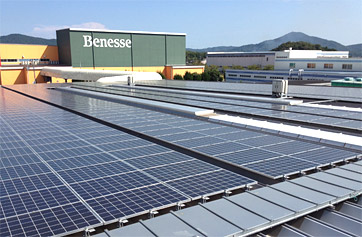
-
<Motion sensors installed in air conditioning systems>
At the Benesse Logistics Center, the first phase of air conditioning system upgrades was carried out in 2014. Sensors were installed that automatically turn the air conditioning on and off based on people's movements.
Furthermore, this construction project eliminated the use of heavy oil within the center. Heavy oil is a finite fossil fuel and requires regular replenishment. Therefore, meticulous consideration of the surrounding environment was necessary during refueling and storage.
In 2019, we carried out the second phase of air conditioning system upgrades and insulation improvement work, resulting in a 60% reduction in annual CO2 emissions across both phases (compared to 2013 levels). Furthermore, at the Second Benesse Logistics Center, air conditioning system upgrades and LED lighting conversions in 2020 resulted in a 30% reduction in annual CO2 emissions (compared to 2019 levels).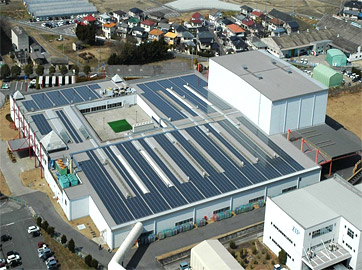
- Efforts toward environmentally friendly modal shift
-
< Kodomo Challenge > is actively working on modal shift by using freight rail transport, which has low CO2 emissions, for long-distance transportation (over 500km) of products and services such as "Shinkenzemi". Because more than 60% of its long-distance transportation is done by freight rail, it was selected as an "Eco-Rail Mark" certified company in March 2020.
Switching from truck transport to rail container transport requires various innovations.
At our logistics center in Okayama, containers are parked right at the exit, allowing for immediate loading and shipping, or scheduling adjustments are made to enable transportation by rail container. Furthermore, to reduce energy consumption in transportation, we design product shipping packages to be as waste-free as possible and provide monthly forecasts of the number and volume of items to our shipping companies, thereby promoting the efficient use of containers and trucks.
Initiatives at related facilities
- Benesse House 's commitment to sustainability
-
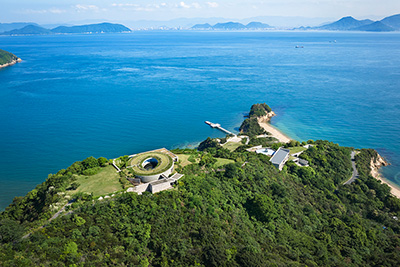
Benesse Corporation and Fukutake Foundation (Public Interest Incorporated Foundation) are promoting "Community development" through contemporary art and cultural development. For approximately 30 years, they have been developing art activities collectively known as "Benesse Art Site Naoshima" on the islands of the Seto Inland Sea. Benesse Art Site Naoshima is characterized by its activities that utilize history and culture while introducing new contemporary art and revitalizing relationships with local residents. Many people visit every year, and it has become a place to think about "Benesse = Well-Being" through art works, the scenery of the Seto Inland Sea, and interactions with local people.
Benesse House, a facility located at Benesse Art Site Naoshima is based on the concept of "coexistence of nature, architecture, and art." It aims to contribute to the realization of a sustainable society and promotes sustainability in various aspects, including environmental considerations, health, and safety.
You can find more details about our initiatives below.
environmental education
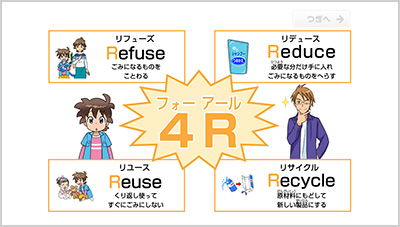
Through various educational materials, services, and events, we provide environmental education services tailored to children's developmental stages, promoting understanding of climate change and taking action to address it. We also conduct annual environmental training for our employees.
For details on each initiative, please see below.
Responding to and supporting public regulations
At each of our locations, we support laws, regulations, and policies related to climate change and energy consumption reduction (such as the "Act on Promotion of Global Warming Countermeasures" and the "Act on Rationalization of Energy Use" in Japan) and take appropriate measures to address them.